LinkedIn for GovCon · 2026 Topic Cluster & GEO Strategy
LinkedIn Topic Clusters & GEO Strategy for Government Contractors in 2026
If your LinkedIn reach dropped in 2024, the problem is not your expertise. LinkedIn’s new 360Brew AI system now rewards topic authority, not random posting. This page explains how small business government contractors can use LinkedIn topic clusters and Generative Engine Optimization (GEO) to stay visible to federal buyers in 2026.
When contracting officers, program managers, or teaming partners search for your NAICS-aligned skills, your profile and content should appear with a clear, confident message about what you do and who you serve.
Below, you’ll see a simple, proven framework to rebuild your LinkedIn strategy around topic clusters, AI search, and GovCon-specific positioning.
Request a LinkedIn Visibility Review
Updated for 2026 LinkedIn & AI search changes.
The Problem: Your Old LinkedIn Strategy Stopped Working
For years, small business GovCon owners followed a simple plan on LinkedIn: post often, add hashtags, comment when you had time, and hope federal buyers found you.
Then in 2024, views dropped and engagement went flat. Posts that used to work suddenly hit a wall. Many owners assumed LinkedIn was “dead” or that no one cared.
The real story is different: LinkedIn did not break. It evolved.
LinkedIn replaced its older algorithms with one massive AI system called 360Brew—a large language model that reads and understands content. Instead of rewarding volume and generic engagement, it now rewards topic authority.
Random posts now create random visibility. Topic clusters create strategic visibility.
What’s at Stake for Government Contractors
Federal buyers today have less time, tighter budgets, and more pressure to find the right contractors quickly. They do not scroll LinkedIn hoping to discover you.
Buyers turn to search and AI tools. They ask questions like:
- “Who helps small DoD contractors with CMMC compliance?”
- “Which firms support federal health agencies with cybersecurity?”
- “Which 8(a) firms have experience with facility maintenance for federal buildings?”
If your LinkedIn profile and content are vague, scattered, or off-topic, AI systems and LinkedIn’s search do not know where to place you. That makes you effectively invisible just when buyers are looking for exactly what you do.
"Invisible companies do not win government contracts."— Cecilia McDonnell, LinkedIn for GovCon
LinkedIn now runs on an interest graph instead of only a social graph.
The old system looked mostly at who you know and what they like.
The new 360Brew system reads your content, understands the topics in it,
and places you on an interest graph of professional expertise.
For example, 360Brew understands that “CMMC compliance,” “NIST 800-171,”
“System Security Plans (SSP),” and “DFARS” all belong to the same
cybersecurity compliance ecosystem for DoD contractors.
When you consistently post about related subtopics in your area of expertise,
you teach LinkedIn’s AI where you belong. You are building topic authority.
At the same time, Generative Engine Optimization (GEO)
helps your content appear in AI-generated answers from tools like ChatGPT,
Perplexity, Google’s AI Overviews, and Claude when people ask about your niche.
Topic clusters are the bridge between LinkedIn’s 360Brew model, AI search tools,
and your NAICS-aligned capabilities.
A topic cluster is a simple content structure:
This works with LinkedIn’s AI system because it offers:
You are not trying to game an algorithm. You are communicating clearly with
AI systems that read and understand text at scale.
Here is a simple three-step framework you can use to build your own topic cluster
as a government contractor:
Let’s use a familiar example:
a small business focused on cybersecurity compliance for DoD contractors.
Your pillar could be:
“Cybersecurity compliance for small DoD contractors.”
This becomes your authority hub on LinkedIn and in AI search.
Cluster topics might include:
To give LinkedIn’s AI a clear, consistent pattern, you could:
When your topic cluster is in place and consistent, several things begin to change:
Instead of guessing what to post, you follow a clear structure that shows your expertise,
supports your NAICS-aligned offers, and reinforces your value to federal buyers.
The New Solution: Topic Clusters + 360Brew + GEO
What Is a Topic Cluster?
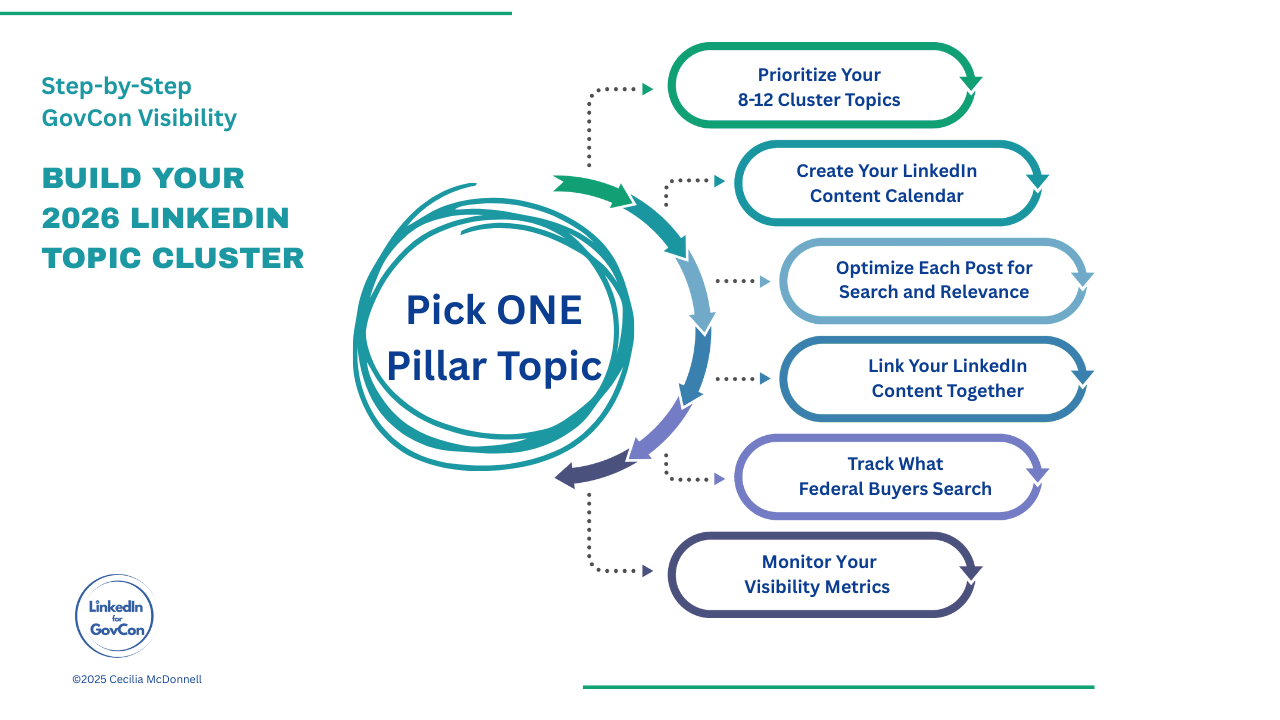
The 3-Step Framework for LinkedIn Topic Clusters in 2026
Choose one core capability aligned with your primary NAICS code or the contracts
you most want to win.
Map out buyer questions, pain points, and related subtopics that support your pillar.
Post cluster content weekly, connect it back to your pillar, and use analytics
to see what draws federal buyers to your profile.
Step-by-Step: Example Topic Cluster for a GovCon Firm
Step 1: Choose Your Pillar Topic
Step 2: Map Supporting Cluster Topics
Step 3: Build Your LinkedIn Content Schedule
Visual: Building Your 2026 LinkedIn Topic Cluster
What Life Looks Like on the Other Side
About Cecilia McDonnell and LinkedIn for GovCon
I help small business government contractors get seen by federal buyers, prime contractors, and teaming partners using LinkedIn and integrated visibility strategies.
As the creator of “LinkedIn for GovCon” and the 2026 Visibility Framework, I focus on practical implementation, not theory. My work is about helping you build a clear, search-optimized presence that aligns your LinkedIn profile, content, NAICS codes, and capability statements.
LinkedIn Strategies for GovCon is published weekly and now serves more than 1,500 subscribers.
Topic clusters are a core part of how I help firms step out of invisibility and into consistent federal visibility.

Ready to Build Your LinkedIn Topic Cluster for 2026?
If your company has strong past performance but low visibility on LinkedIn, your issue is not your capability. It is your content structure.
Topic clusters aligned with your NAICS codes and federal offers can change how buyers and AI tools see you—without turning you into a full-time marketer.
Together, we can:
- Clarify your pillar topic and cluster themes.
- Align your LinkedIn profile with your federal positioning.
- Design a practical 90-day content plan that fits your schedule.
FAQ: Topic Clusters for LinkedIn Visibility in 2026
How long does it take to see results from topic clusters on LinkedIn?
Most professionals see clear movement within about 90 days of steady, focused posting. That is how long it usually takes for LinkedIn’s system to categorize your expertise and start boosting your content. Think of it as training LinkedIn’s AI to understand your niche in government contracting.
Why did my LinkedIn reach drop in 2024 if I was posting regularly?
LinkedIn’s system no longer looks only at clicks and connection counts. It reads meaning and context. If your posts jump between unrelated topics, the system cannot easily decide what you are an expert in, so it does not know which federal buyers to show your content to. Topic clusters fix that by creating a clear throughline.
Can I have more than one topic cluster on LinkedIn?
Yes, but start with one. Master a single pillar topic for at least 90 days. Once you are getting found for that expertise—through search appearances and relevant profile views—you can add a second pillar around another government contracting skill.
What if I offer multiple services to federal buyers?
Pick the service that has the highest contract value or the most opportunity right now. LinkedIn rewards clear thinking and topic focus over scattered expertise. You cannot be known for everything. Focus builds authority.
How is a topic cluster different from just posting regularly on LinkedIn?
Random posts create random visibility. Topic clusters create strategic visibility. You are training LinkedIn’s system to connect you with specific federal buyer searches. The system now reads your profile and posts as text to understand your niche and boost your content to the right people.
Do hashtags still matter for LinkedIn visibility in 2026?
Hashtags still play a small supporting role. You can use two or three highly relevant tags
such as #GovCon and #FederalContracting,
but 360Brew now prioritizes topic authority, real engagement,
and industry-specific insight over generic hashtag reach.
What if my competitors start doing topic clusters too?
That confirms you are on the right track. Federal buyers will still look for depth, clarity, and a focused track record. Starting earlier and posting more consistently gives you an advantage. You are not trying to avoid competition; you are working to be the most credible option in a defined space.
How do I know if my LinkedIn topic cluster is working?
Watch for more search appearances, profile views from outside your network, and activity from titles like contracting officer, program manager, or teaming coordinator. Look for higher-quality connection requests, InMail from agencies, and engagement from decision-makers, not just peers and competitors.
What is the biggest mistake people make when building topic clusters?
The biggest mistake is jumping around too soon. Pick your lane in government contracting and stay with it for at least 90 days. LinkedIn’s AI needs that steady pattern to categorize you and boost your content. Patience and consistency beat sporadic bursts of activity every time.
Can topic clusters help with SAM.gov and other government contractor marketing?
Yes. The authority you build on LinkedIn supports your broader federal visibility. As buyers research your company name or search for firms in your NAICS code, your LinkedIn content can appear in search results. A strong LinkedIn presence also reinforces your capability statements, DSBS/SBS listing, and past performance narratives.