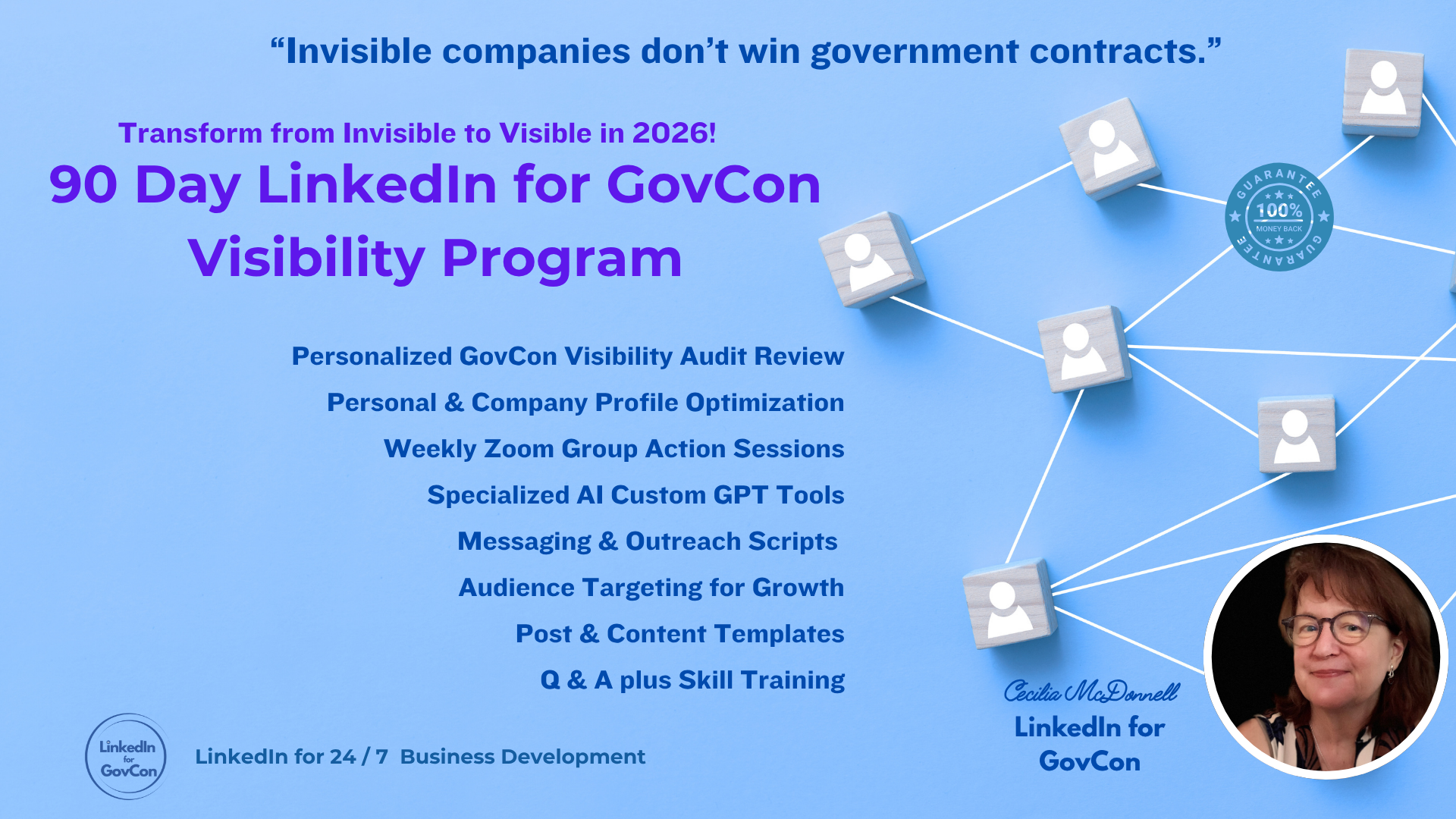
90‑Day LinkedIn Visibility Blueprint for Government Contractors in B2B/B2G
Apr 01, 2026
Author: Cecilia McDonnell
Publisher: LinkedIn for GovCon
This article is for small-business government contractors at $1M+ who want to use LinkedIn to sharpen pre-RFP positioning, get noticed by hidden buyers, and squeeze more ROI out of every business development hour in 2026.
How to build a real LinkedIn presence without AI comment tools or engagement pods
If your LinkedIn “strategy” relies on AI tools to sound engaged, it is time to rethink your approach. For government contractors in the B2B or B2G space, the consideration is more than just lower reach. It is how federal buyers, primes, and partners find you and qualify you based on your reputation online. A poor LinkedIn presence can get knock you out of the running without you even knowing it.
In this article, I'll show you an effective 90‑Day LinkedIn Visibility Blueprint that helps busy B2B/B2G government contractors use LinkedIn for effective business development. I'll show you a practical roadmap for leaders who want to be visible, credible, and discoverable—without depending on AI comment tools or engagement pods to look active. You will see how to position your niche, show proof of performance, and engage in a way the 2026 LinkedIn algorithm and real humans both reward.
Why AI comment tools are a problem in GovCon
LinkedIn has shifted to reward real, back‑and‑forth conversations and penalize obviously automated, low‑quality comments. You can see it in your own feed: generic “Great post!” responses and bot‑sounding threads do not travel like they used to.
For government contractors, that is not just annoying. It is dangerous to your reputation. Federal buyers, program managers, and contracting officers are using LinkedIn to do market research, check your footprint, and get a feel for your credibility. They can spot automation and low‑effort engagement a mile away.
When your activity tab is filled with meaningless, AI‑generated comments on random posts, you are sending the opposite signal of what you intend. Instead of being seen as a thoughtful, trustworthy small business, you look careless and inauthentic.
In a relationship‑driven, risk‑averse market like GovCon, your reputation is your most important asset. You cannot afford to outsource it to a bot.
What LinkedIn now rewards in 2026
The recent updates to LinkedIn’s algorithm are actually simple once you strip away the noise. The platform is pushing distribution toward three things.
- First, original posts that keep people on LinkedIn and spark real conversation.
- Second, comments that add perspective, experience, or analysis instead of one‑line praise. Third, consistent, human engagement with a defined audience, not spray‑and‑pray activity across random posts.
- For B2B/B2G GovCon founders, BD leaders, and capture managers, that is good news. You do not need to game the system with hacks, pods, or tools that pretend to be you. You need a focused LinkedIn visibility system that showcases your federal niche, your past performance, and your ability to think through agency problems in public.
That is exactly what this 90‑day LinkedIn visibility blueprint is designed to help you build.
 The GovCon PRE Framework (no bots required)
At LinkedIn for GovCon, I use a simple but powerful framework I built in 2018 to build federal‑grade visibility called the P- R- E Framework for GovCon Visibility.
Positioning. Reputation. Engagement.
Here is how PRE translates into a LinkedIn strategy for B2B/B2G government contractors.
• Positioning
Positioning is how you show up in search and in the first five seconds when a federal buyer lands on your profile or company page. It answers questions like:
Who do you actually serve? Which agencies, missions, and problems?
What is your federal niche, by NAICS, set‑aside status, and capability?
Why would a program manager, contracting officer, or prime keep reading?
On LinkedIn, positioning shows up in your headline, About section, Experience entries, creator mode topics, and the links back to your website, SAM, and DSBS. When we optimize your positioning, we rewrite your headline and About so that a federal buyer can understand exactly who you are, what you do, and why you matter in one glance. We also align your LinkedIn narrative with your capability statement and your GovCon website, so the message is consistent and keyword‑rich everywhere.
• Reputation
Reputation is the story your content and profile tell when you are not in the room. In GovCon, buyers and primes are looking for consistency, clarity, and evidence that you understand the environment they operate in.
On LinkedIn, reputation shows up in the stories you tell about projects, contracts, and missions, the lessons you share from debriefs and teaming, and the way you discuss risk, compliance, and outcomes. One of the simplest ways to upgrade your reputation signals is to turn your Featured section into a digital capability statement. That often includes case study snapshots, NAICS and PSC highlights, key contract wins, interviews or podcasts, and links to deeper proof on your site.
• Engagement
Engagement is not “leave 50 random comments per day.” It is the deliberate act of showing up in front of the right people with the right perspective.
On LinkedIn, engagement shows up in who you connect with and follow, whose posts you comment on consistently, and how you move from public conversations into private, professional dialogue. Instead of joining comment pods or plugging into an AI comment tool, I help clients create a short “Federal Buyer and Prime Visibility List” of 10–30 people and pages.
That list usually includes program managers, contracting officers, small business specialists, OSDBU reps, large primes, and key industry voices in your niche.
Then, we build a human, sustainable engagement routine you can execute in 10–15 minutes per day. Often the first step is waking up the connections you already have.
A real‑world example of visibility in action
Here is what this looks like in practice for one healthcare growth strategist and GovCon founder.
“Cecilia McDonnell’s ‘How to Talk to Strangers: A Masterclass for Government Contractors’ was a game changer for me. A dynamic speaker, she blends light humor with pragmatic strategies that are easy to implement. Shortly after, I worked with her to update my personal profile and my healthcare management company LinkedIn page.
Cecilia helped me reframe my GovCon niche and narrative. Her focus on keyword‑rich communication changed how we show up in search results and how we engage buyers and other professionals on LinkedIn. If you are a government contractor feeling invisible or unsure how to build traction online, you want Cecilia in your corner.”
– Tonya M. Davis, MBA, CEO, 5D Healthcare Management
This is the power of positioning, reputation, and engagement working together. No pods. No fake comments. Just clear messaging, smart keyword use, and consistent human visibility in front of the right audience.
Your 90‑day LinkedIn Visibility Blueprint
Forget the advice that tells you to post three times a day or to comment on 100 random posts. As a B2B/B2G GovCon founder or BD lead, you do not have time for that, and the algorithm does not reward it anymore.
Here is a realistic 90‑day LinkedIn visibility blueprint you can follow instead.
Phase 1 (Weeks 1–3): Fix the foundation
Clarify your GovCon niche: agencies, missions, NAICS, set‑aside status, and core capabilities. Rewrite your headline and About to speak directly to program managers, contracting officers, and primes. Update your Experience entries so they support your current focus instead of reading like an old resume.
Then, build your Federal Buyer and Prime Visibility List of 10–30 people and pages. Include federal buyers, small business specialists, large primes, and relevant B2B/B2G partners. This is the audience you will show up for consistently.
Phase 2 (Weeks 4–8): Publish proof
Aim for two to three posts per week. Each week, create:
One visibility post where you explain a federal problem you solve in plain language.
One proof post where you share a short, anonymized past‑performance story, teaming win, or case study.
One perspective post where you talk about a lesson from a debrief, a clause, an implementation challenge, or a mission you support.
At the same time, spend 10–15 minutes per day engaging on posts from your visibility list. Add context, ask thoughtful questions, and connect their topic to your experience in government environments. Do not use AI to generate the comments. Use your own voice so your expertise and personality come through.
Phase 3 (Weeks 9–12): Turn visibility into conversations
Continue posting and engaging on the same rhythm. Start using select posts to invite low‑pressure conversations. For example, you might say: “If you are wrestling with [specific issue] at [type of agency or organization], message me ‘[keyword]’ and I will send a short outline of how teams are tackling it.”
When the right people view your profile or engage with your content, follow up with a short, respectful direct message that acknowledges their work and offers a concrete next step if it makes sense. Throughout the 90 days, track where your meetings and opportunities start. Profile views, comments, DMs, and referrals matter more than vanity metrics.
Why I do not use AI comment tools on LinkedIn
I use AI heavily for research, idea generation, and drafting behind the scenes. I do not use it to pretend to be you.
There are three reasons.
First, compliance and risk. Federal buyers and primes are trained to assess vendor risk. Obvious automation in your comments and content can raise questions you do not want to answer when a contract is on the line.
Second, signal versus noise. LinkedIn is already reducing distribution for low‑quality, repetitive engagement. Filling your feed with generic AI comments makes it harder for serious buyers and partners to see what you actually think.
Third, GovCon is a relationship market. Relationships in this space are built on trust, responsiveness, and subject‑matter depth over time. You cannot outsource that trust to a bot or a pod. You can use AI to help you think, but not to replace your presence.
My philosophy at LinkedIn for GovCon is simple: protect your reputation first, then expand your visibility in ways that are sustainable for you and your team.
What to measure instead of vanity engagement
Most LinkedIn advice stops at impressions, likes, and follower count. In GovCon, those numbers are incomplete at best and misleading at worst.
Here is what I encourage B2B/B2G government contractors to measure instead.
Track search appearances from the right titles at the right organizations, such as program managers, contracting officers, small business specialists, and business development leaders at your target agencies and primes. Watch profile views from the right agencies and companies, not just “more” views.
Look at new conversations, meetings, and proposal invitations that can be traced back to LinkedIn activity. Pay attention to growth in connection density inside a specific agency, office, or prime. When those metrics move, you are not just “doing content.” You are building a visibility system that feeds your pipeline.
What my clients say
It is one thing to talk about visibility. It is another to be trusted to help senior GovCon leaders and founders implement it.
“Cecilia brings energy to all she does and a new perspective to marketing and sales in the GOVCON marketplace. She provides personalized attention to individuals and organizations, freely sharing the research, knowledge, and advice they need to maximize visibility and drive growth.
A pleasure to work with and an irreplaceable asset and mentor.”
– Bernard “Bernie” W. Jackson, VP and Senior Capture Manager, Raven Advisory LLC
If you are a small or midsize B2B/B2G government contractor who feels invisible on LinkedIn, or you are tired of hearing that you simply need to “be more active,” there is a better way.
 Next step: build your 90‑day LinkedIn visibility plan
You do not need to become a full‑time content creator to make LinkedIn work as a 24/7 business development engine. You do need a clear niche, a visible profile, and a manual‑first engagement plan that respects your time and your reputation.
That is exactly what I build with you inside the LinkedIn for GovCon visibility programs.
If you are ready to replace AI comment tools and random activity with a focused 90‑day LinkedIn visibility blueprint tailored to federal buyers, primes, and B2B/B2G partners, your next step is simple.
SCHEDULE A CALL WITH Cecilia McDonnell. We will review where you are today, identify your biggest visibility gaps, and outline what the next 90 days can look like for your GovCon brand on LinkedIn.
FAQ: How federal buyers actually find you on LinkedIn
How do federal buyers actually find small businesses on LinkedIn?
Federal buyers, primes, and partners rarely “browse” at random. They search by keywords, agency‑specific needs, and job titles, then scan your headline, About, and Featured section to see if you fit a specific problem or mission. If you are not using the language they use in market research and capability discussions, you are effectively invisible.
Is LinkedIn even worth it if most opportunities live on SAM.gov?
Yes, because SAM, DSBS, and LinkedIn work together. SAM and DSBS tell buyers you exist. LinkedIn shows them who you are, what you think about their challenges, and how other agencies and partners already trust you. Many shortlists and teaming decisions are influenced by what people see on your profile and content.
Should GovCon firms use automation or AI tools on LinkedIn?
You can use AI behind the scenes to research, brainstorm, and draft, but you should not use tools that pretend to be you in comments or DMs. For government contractors, obvious automation is a reputation risk. Federal buyers and primes are assessing whether you are trustworthy and attentive. They expect you—not a bot—to show up in conversations.
How much time should a B2B/B2G GovCon leader spend on LinkedIn?
Most of my clients start with 30–45 minutes per week for content and 10–15 minutes per day for focused engagement. With a clear 90‑day visibility blueprint and a Federal Buyer and Prime Visibility List, that is enough to build consistent, human visibility without burning you out.
What does Cecilia McDonnell say is included in the 'GovCon Marketing Ecosystem'?
A fully optimized GovCon Marketing Ecosystem for government contracting includes your –
- Elevator pitch or short capability narrative that tightly conveys your value proposition;
- Company profile on the SBA's SBS system and SAM.gov;
- GovCon-specific Capability Statement;
- GovCon page of your website
- LinkedIn personal profile
- LinkedIn company page.
You need a consistent marketing message across these core marketing assets.