LinkedIn Strategy for Government Contractors: How to Find Federal Buyers, Build Teams, and Win Business
May 05, 2026
Government contractors use LinkedIn to find federal buyers, join winning teams, and start conversations that create revenue. The most effective strategy combines three elements: an optimized profile that attracts the right people, content that proves your expertise, and clear calls to action that move buyers off the platform and into a conversation.
Many contractors post and hope for the best. The ones who win treat LinkedIn as an active business development tool - not a resume or a social network. If you want to attract federal buyers and teaming partners consistently, you need a repeatable plan.
Here is the fastest path to making LinkedIn work for your GovCon business.
1. Make Your Profile a Magnet for Federal Business
Your LinkedIn profile is like your company's front door. It’s often the first thing a potential buyer or partner sees, so it has to be effective.
An optimized LinkedIn profile is dynamic and attractive.
- A Clear Headline: Your headline shouldn't just state your job title. It's your promise to a client. It should quickly say what you do and for whom. Instead of "CEO at Tech Solutions," try something like, "Helping DoD agencies secure their networks with top-tier cybersecurity." This immediately tells a potential buyer what you can do for them.
- Use the Right Keywords: Federal buyers and partners search for specific skills. Your profile—especially the "About" section—must use the niche keywords and terms they use when looking for companies like you? What specific acronyms, contract vehicles, and mission-critical systems related to your work? If you work on IT modernization for the Department of Veterans Affairs, your profile should mention those exact words.
- Show, Don't Just Tell: Don't just list your accomplishments. Show them off. Put your capability statements, case studies, and corporate videos in the "Featured" section. This makes it easy for visitors to see your past work and value quickly.
Remember, it's about attracting the right people. You want a federal buyer to find your profile and think, "This is exactly who we've been looking for."
2. Create Content That Proves Your Expertise
Content is how you build trust and show you are an expert. It's what turns a profile visitor into a potential client. The content you create should teach, inform, and solve problems for your audience. Ultimately, you want to trigger conversations.
- Educational Posts: Share insights and lessons learned from your industry. Don't just share news; explain what it means for federal agencies or what problems they might face.
- Case Studies and White Papers: Summarize these in a LinkedIn article or post. This can bring people to your website and prove your skills. For example, you could write an article called "How We Helped the Army Improve Logistics: A Case Study."
- Industry Analysis: A well-written thought leadership article will spotlight you as a leader in your field. Write about recent government challenges or emerging technologies important to your work. This shows you're a trusted expert, not just a vendor.
- Live Events: Hosting a LinkedIn Live event on a topic that interests federal buyers can be a game changer. It allows you to show your expertise in real time, answer questions, and connect directly with your audience.
The goal is to provide real value. When you consistently share helpful content, you build trust, making potential clients more likely to want to work with you.
3. Use Clear Calls to Action (CTAs)
You've built an amazing profile and created great content, but you can't assume people will take the next step on their own. You need to be specific about what you want them to do. This is where a clear call to action (CTA) comes in.
To start a conversation, you can ask a simple question in your post: "Does your agency (or business) face a similar challenge?" This encourages people to engage without being too pushy.
To move people off the platform for a meeting, your CTA needs to be more direct. Your audience needs to know exactly what you want them to do next.
Here are a few examples:
- "If this is a challenge your agency is facing, let's talk about solutions. Here's a link to my calendar..."
- "If this is a good fit for you, I'd like to share a demo. DM me and we can set up a time in the next few days."
- "Ready to talk about a partnership on an upcoming bid? Send me a direct message, and let's connect this week."
An effective CTA provides a clear path forward. It makes it easy for a potential buyer or partner to take the next step.
If your profile and content are not high quality, people will hesitate to take a call. They need to see that you are serious and worth their time.
By following this three-part plan, you can turn your LinkedIn profile into a powerful tool for business development and winning government contracts.
Remember that LinkedIn is one part of your GovCon Marketing Ecosystem,
_______________
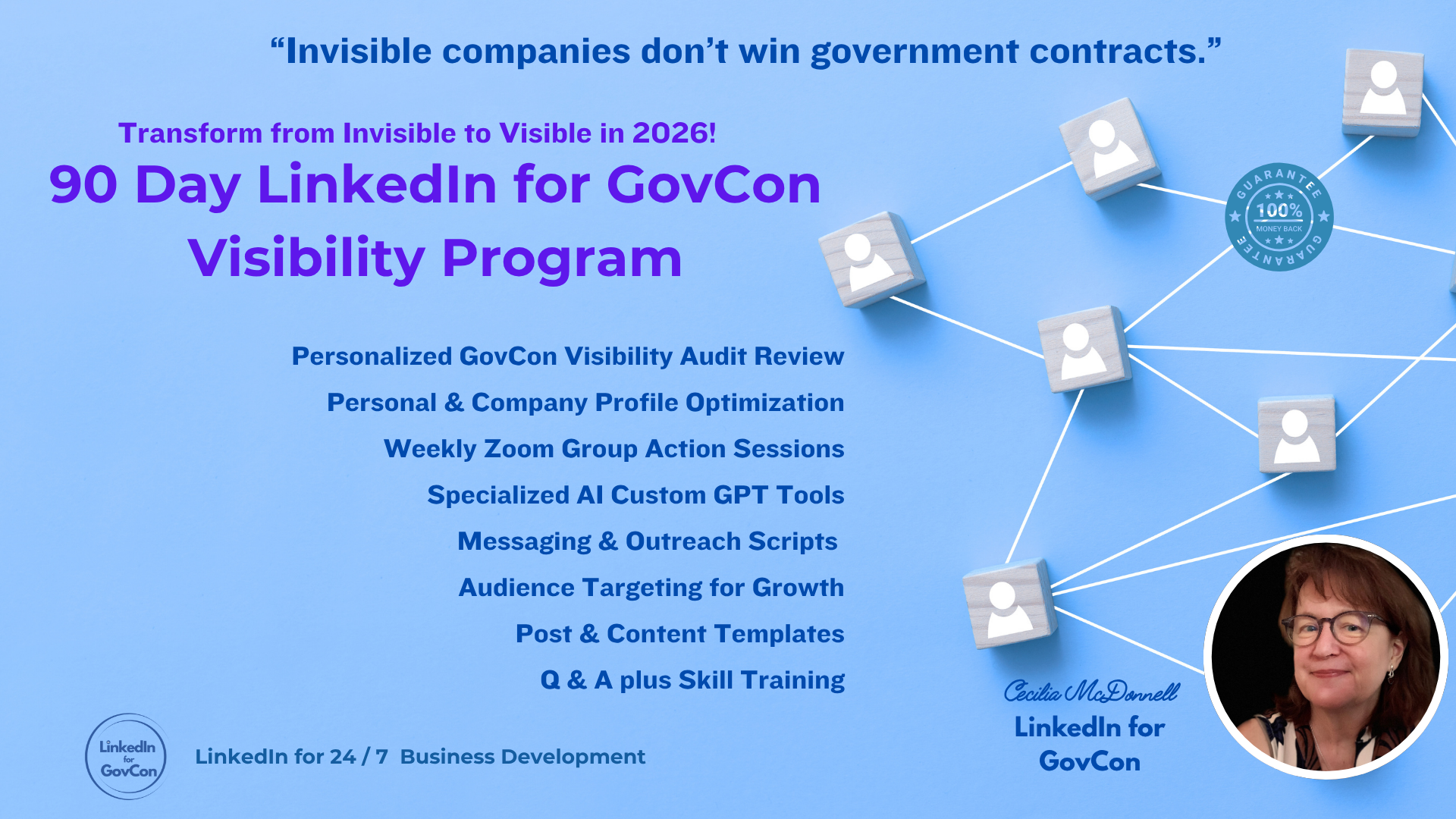
"Invisible companies don't win government contracts."
Not sure where you stand? Take the free Visibility Quiz
Frequently Asked Questions
What is the best LinkedIn strategy for government contractors?
The most effective LinkedIn strategy for government contractors combines three elements: an optimized profile that uses federal procurement keywords, consistent content that demonstrates subject matter expertise, and direct calls to action that move buyers into a one-on-one conversation. Contractors who treat LinkedIn as an active business development tool - not a passive resume - consistently outperform those who simply post and wait.
How do government contractors find federal buyers on LinkedIn?
Government contractors find federal buyers on LinkedIn by optimizing their profiles with agency-specific keywords, NAICS codes, and contract vehicle names that procurement officers and program managers search for. Regularly publishing content that addresses federal agency challenges - and engaging directly in comments and messages - increases visibility to the right decision-makers over time.
What should a government contractor put in their LinkedIn headline?
Your LinkedIn headline should clearly state what you do and who you serve - not just your job title. For example, instead of "CEO at Tech Solutions," a stronger headline is "Helping DoD Agencies Secure Their Networks with Certified Cybersecurity Solutions." A strong GovCon headline includes your core capability, the agency or mission area you serve, and a relevant certification such as 8(a), WOSB, or HUBZone if applicable.
How do small businesses win government contracts using LinkedIn?
Small businesses win government contracts through LinkedIn by building relationships with prime contractors, agency program managers, and procurement officers before an opportunity is released. Pre-RFP positioning - being known and trusted before the solicitation drops - is one of the most underused advantages small businesses have on LinkedIn.
What keywords should government contractors use on LinkedIn?
Government contractors should use the specific language federal buyers search for, including NAICS codes, contract vehicle names (GSA MAS, SEWP, CIO-SP3), agency acronyms (DoD, VA, HHS, GSA), and mission-critical system names relevant to their work. The "About" section and headline are the highest-priority places to include these terms.
How often should a government contractor post on LinkedIn?
Government contractors should aim to post on LinkedIn three to five times per week to build consistent visibility with federal buyers and teaming partners. Consistency matters more than volume - LinkedIn's algorithm rewards regular engagement and begins to associate your profile with specific topics, making you more likely to appear in the feeds of the buyers you want to reach.
What is the difference between LinkedIn for B2B and LinkedIn for GovCon?
While general B2B LinkedIn strategy focuses on broad lead generation and sales funnels, GovCon LinkedIn strategy is built around pre-RFP positioning, teaming relationships, and federal procurement language.
Federal buyers and prime contractors search differently than commercial buyers - they look for specific certifications, clearances, contract vehicles, and agency experience. A GovCon-specific LinkedIn strategy accounts for these unique search behaviors and relationship dynamics.
How can competitor research improve my LinkedIn visibility?
Competitor research will show you which topics, keywords, and positioning styles are already working in your market. Once you know that, you can build a stronger LinkedIn profile, create more relevant content, and avoid sounding too generic or too broad for federal buyers.